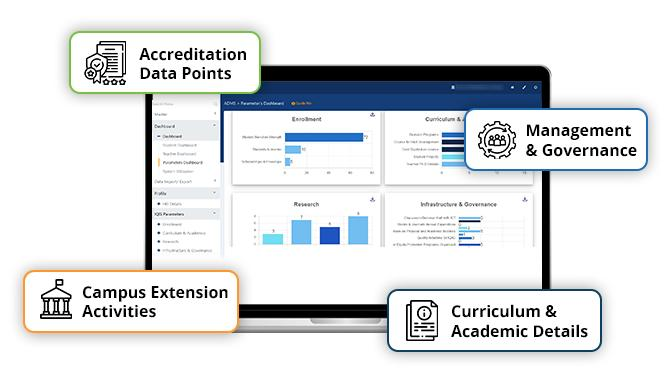
NAAC Ready@SD College Accreditation Preparation, Documentation & Evidence Management
Welcome to NAAC Ready@SD College – a dedicated Moodle platform for systematic NAAC accreditation preparation, documentation, and evidence management.
This course serves as a centralized workspace for IQAC, NAAC criteria coordinators, departmental coordinators, and faculty members to access guidelines, maintain criteria-wise records, upload supporting documents, share reports, and monitor documentation progress.
The course aims to promote a structured, collaborative, and evidence-based approach to accreditation preparation by ensuring that relevant documents are accurate, updated, properly organized, and readily available for verification.
Key Focus Areas:
Criteria-wise guidelines, manuals, and documentation requirements
Uploading and maintaining supporting documents and reports
Department-wise data collection and evidence management
Sharing best practices, formats, and templates
Monitoring documentation progress and pending requirements
Review, verification, and validation of submitted records
Continuous quality enhancement through IQAC coordination
Our Goal: To ensure effective coordination, transparent documentation, and timely completion of NAAC accreditation requirements through a collaborative digital platform.
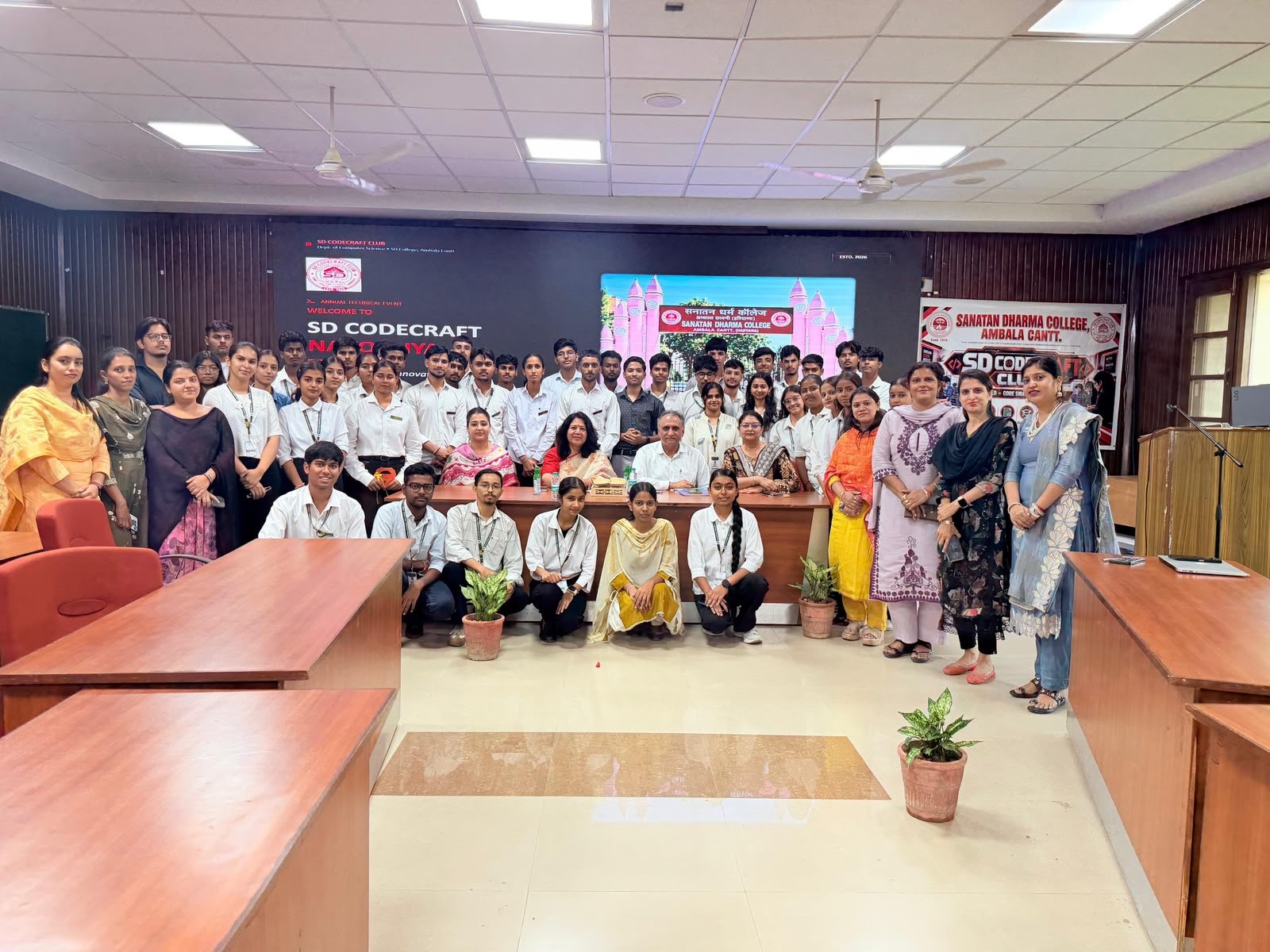
SD Codecraft Club
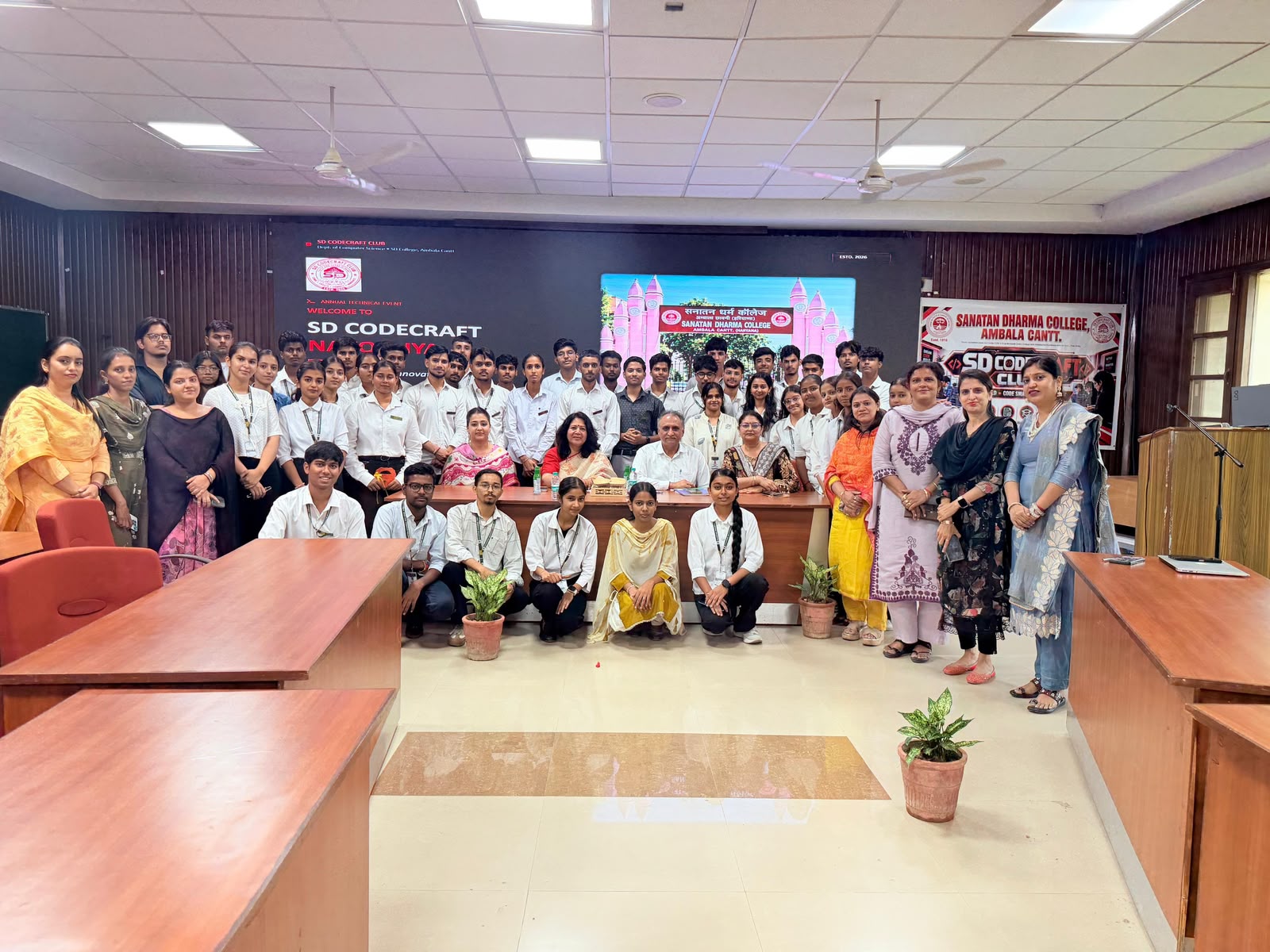
SD CodeCraft Club
CODE • CREATE • COMPETE • INNOVATE
Welcome to the SD CodeCraft Club Moodle Course!
SD CodeCraft Club is a Faculty-Guided, Student-Led and Student-Driven coding and technology community of the Department of Computer Science, SD College, Ambala Cantt. The club brings together students who are passionate about programming, technology, problem-solving, projects and innovation, providing a platform to learn, build, collaborate and compete.
What This Course Offers
Through this Moodle course, members will get access to:
- Programming & Coding Challenges – Practice programming, problem-solving, debugging and logical thinking.
- AI & Emerging Technologies – Explore Artificial Intelligence, Generative AI, Machine Learning and new technologies.
- Web & App Development – Learn and build practical websites, applications and digital solutions.
- Cybersecurity – Develop awareness of cybersecurity, secure coding and security challenges.
- Game Development – Explore game development and creative coding.
- Projects & Innovation – Turn ideas into working projects and showcase innovative solutions.
- Hackathons & Competitions – Participate in hackathons, codeathons, coding contests and technical events.
- Peer Learning & Collaboration – Learn from fellow students, share knowledge and work in teams.
- Career & Placement Preparation – Strengthen coding interview skills, problem-solving abilities and industry readiness.
- Events & Digital Activities – Stay updated about club activities, workshops, announcements and opportunities.
Who Can Join?
The club welcomes students from BCA, BCA (AI), B.Voc Software Development, B.Sc IT and B.Sc Computer Science, as well as other students who have a genuine interest in programming and technology.
You do not need to be an expert programmer to join. Whether you are a beginner, intermediate learner or an experienced coder, there is a place for you to learn, contribute and grow.
Our Philosophy
CodeCraft is not about titles—it is about responsibility, learning, teamwork and contribution.
Every member is encouraged to:
Learn • Build • Collaborate • Share • Compete • Innovate
Faculty Coordinator
Ms. Amandeep Kaur Mehta
Department of Computer Science
SD College, Ambala Cantt
SD CodeCraft Club — More Minds • More Ideas • Mo

Object Oriented Programming using C++
This course introduces students to the fundamentals of Object-Oriented Programming (OOP) using C++. It begins with detailed input/output operations including unformatted and formatted I/O, stream handling, and the use of insertion/extraction operators. Students learn function concepts such as declaration, definition, recursion, inline functions, and various parameter passing methods including pointers. The course builds up to core OOP principles like classes, objects, encapsulation, constructors, destructors, static members, and friend functions. It further explores advanced topics like operator overloading, multiple types of inheritance, virtual and abstract classes, polymorphism, and exception handling. Emphasis is placed on hands-on coding, logic development, and implementation of modular, reusable, and error-handling code structures using C++.
Learning Outcomes:
By the end of this course, students will be able to:
1. Perform structured and object-oriented programming in C++.
2. Use streams, formatted/unformatted I/O, and various I/O functions effectively.
3. Define and use functions with different parameter passing methods including recursion and overloading.
4. Apply OOP concepts such as classes, objects, inheritance, constructors/destructors, and encapsulation.
5. Implement operator overloading and polymorphism for flexible program design.
6. Handle runtime errors using exception handling constructs like try, catch, and throw.


PGDCA-Operating System
An operating system (OS) serves as the fundamental software that facilitates communication between computer hardware and software applications. It acts as a mediator, managing system resources, providing a user interface, and ensuring the efficient execution of programs. In essence, an operating system plays a crucial role in controlling and coordinating the various components of a computer system to enable users to interact with and utilize their devices effectively. This course offers a comprehensive introduction to the principles, functionalities, and components of operating systems, exploring topics such as process management, memory allocation, file systems, and user interfaces. Students will gain a foundational understanding of how operating systems work and their significance in modern computing environments. Through theoretical concepts and practical exercises, participants will develop the skills necessary to comprehend, evaluate, and work with different operating systems effectively.
Certificate course on Moodle LMS-Batch II
Welcome Learners
Moodle is a learning platform designed to provide educators, administrators and learners with a single robust, secure and integrated system to create personalized learning environments. The main objective of this course is to learn about the concepts of Moodle Learning Management System (LMS). Through this Learning Management System our mission is to empower the teachers.
Happy Learning!!!



Reasoning and Aptitude
This course will help you improve Reasoning skills and will prepare you for competitive exams.